
After investing time and money in a dental implant, the biggest worry is often that the implant will be “rejected” and the treatment will have to start over. The concern is reasonable. Dental implants have high success rates, but they are not risk-free. The encouraging part is that most failures are linked to factors that you and your dentist can identify and control.
This article explains what dental implant rejection really means, the six most common causes, the warning signs to watch for, and how to lower your risk.
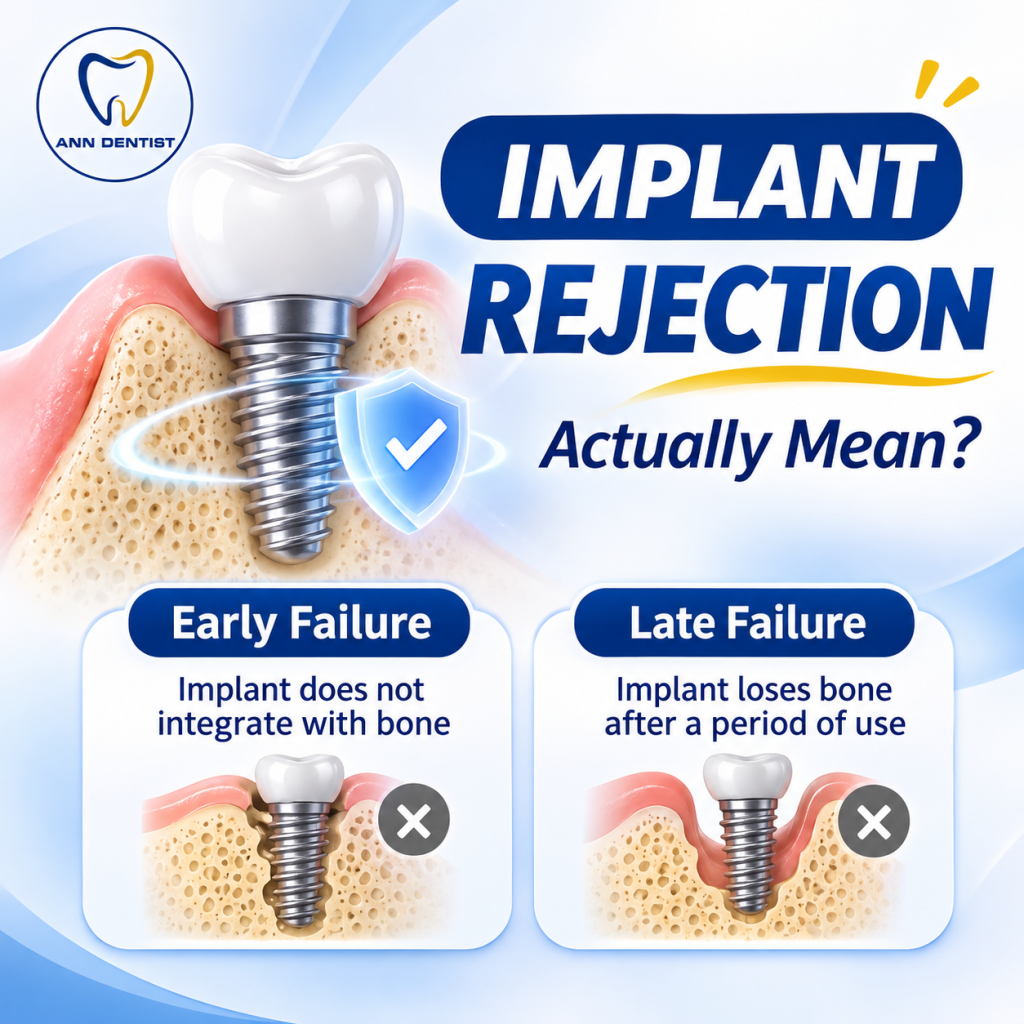
What Does “Implant Rejection” Actually Mean?
In everyday language, “rejection” describes an implant that fails and has to be removed. Medically, however, it is usually not an immune rejection like the kind seen after an organ transplant. Titanium is highly biocompatible, and a true allergy to titanium is uncommon.
Implant failure is generally divided into two types:
- Early failure: the implant does not integrate with the jawbone. It is usually detected within the first weeks to months after placement, because the implant never becomes firmly anchored.
- Late failure: the implant integrates and functions well for a while, then loses surrounding bone because of infection, mechanical stress or other factors. This can occur months or years later.
Knowing the difference explains why two “failed” implants can have very different causes and treatments.
Cause 1: Poor Oral Hygiene and Infection Around the Implant
This is the most common cause of late failure. Bacterial plaque builds up around the neck of the implant and inflames the soft tissue, a condition called peri-implant mucositis. At this stage the inflammation is limited to the gums and is usually reversible with proper cleaning. If it is not controlled, the infection can spread to the bone and become peri-implantitis, in which the bone supporting the implant is gradually destroyed.
These conditions are common. A 2025 systematic review and meta-analysis found that, at the patient level, peri-implant mucositis affected about 46% of patients and peri-implantitis about 21%. Peri-implantitis is also considered a leading cause of implant failure.
Other contributing factors include leftover cement under the gum after the crown is placed, and restorations designed in a way that is difficult to clean.
Could this apply to you? If your gums bleed when you brush around the implant, if you rarely floss or use an interdental brush or water flosser, or if you have gone years without a professional cleaning, address this early.
Cause 2: Smoking
Smoking is one of the risk factors most consistently discussed in implant research. Nicotine and other chemicals in tobacco smoke narrow blood vessels, reduce blood flow to the gums and bone, slow healing and weaken the body’s defense against infection. Smokers have a higher risk of failed osseointegration and of peri-implantitis than non-smokers.
Alcohol deserves a mention too. The same review identified diabetes and alcohol consumption as potential risk indicators for peri-implantitis.
Could this apply to you? If you smoke, tell your dentist before treatment. Cutting down or quitting before and after surgery can meaningfully improve healing.
Cause 3: Medical Conditions and Medications
Whether an implant heals well depends partly on the body’s ability to repair itself. Several conditions need careful evaluation:
- Poorly controlled diabetes: high blood sugar impairs bone healing and raises the risk of infection. People with well-controlled diabetes can usually receive implants but need closer monitoring.
- Radiation therapy to the head and neck: irradiated jawbone may have reduced healing capacity, so treatment must be planned carefully with the oncology team.
- Medications that affect bone metabolism: bisphosphonates (especially intravenous forms) and denosumab are associated with osteonecrosis of the jaw. Osteoporosis itself is not an absolute contraindication, but the drugs used to treat it must be disclosed.
- Autoimmune disease or long-term immunosuppressive drugs: these can reduce resistance to infection and slow healing.
Could this apply to you? Give your dentist a complete medical history and a full list of your medications. Leaving out health information is a common mistake that can affect the outcome of treatment.
Cause 4: Insufficient Bone and Surgical or Planning Errors
An implant needs enough bone around it, in both height and width. If the bone is thin or short and is not augmented with a bone graft, the implant may not achieve adequate initial stability. Several technical problems are frequently discussed:
- Overheating the bone during drilling: classic studies suggest bone can be damaged when its temperature rises above roughly 47°C for a prolonged period, which is why drilling should use cooling irrigation and sharp instruments.
- Malpositioned implants: a recent systematic review concluded that implant malposition plays a crucial role in the onset and progression of peri-implantitis.
- Placing implants too close to neighboring teeth or other implants: this leaves too little bone between them and makes cleaning difficult. Commonly recommended minimum distances are about 1.5 mm from a natural tooth and about 3 mm between two implants.
- Inadequate planning: without a 3D scan (CBCT), the implant size may be chosen poorly or important structures such as nerves and sinuses may not be accounted for.
Could this apply to you? Before surgery, ask about your CBCT results, whether a bone graft is needed, and which implant system will be used. A reputable clinic will explain this plan clearly.
Cause 5: Excessive Biting Force
Implants are anchored directly to bone and, unlike natural teeth, have no periodontal ligament to cushion chewing forces. Excessive or misdirected forces can therefore cause problems. Common situations include:
- Teeth grinding (bruxism) or clenching, especially at night.
- A crown that is too high or a bite that is not properly adjusted, so one tooth carries more load than the others.
- Loading the implant too early: chewing hard on an implant, or attaching a load-bearing restoration before the bone has healed firmly, can cause micromovement that prevents the bone from bonding to the implant.
- A restoration too large for the number of implants, such as a long bridge supported by too few implants.
It should be noted that the role of overload in causing bone loss around implants is still debated in the scientific literature. What is clear is that overload can cause mechanical complications such as loose screws and fractured crowns, and that premature loading can disrupt osseointegration.
Could this apply to you? If you grind your teeth, ask about a night guard. Follow the soft-diet instructions in the early healing period, and report immediately if your bite feels “high.”
Cause 6: History of Gum Disease and Skipped Check-Ups
People who have had periodontitis (gum disease) are at higher risk of peri-implantitis, because the bacteria involved in gum disease can persist in the mouth and colonize the tissue around implants. Periodontitis should be treated and stabilized before implant placement and kept under control afterward.
Missing follow-up visits is another factor. Peri-implantitis often progresses quietly with little pain, so by the time symptoms appear, significant bone may already be lost. Regular check-ups allow your dentist to measure gum pockets, check for bleeding, and take X-rays around the implant to detect problems early.
Could this apply to you? If you have a history of bleeding gums, gum recession or loose teeth, or if you received your implant and never went back for a check-up, schedule an evaluation soon.
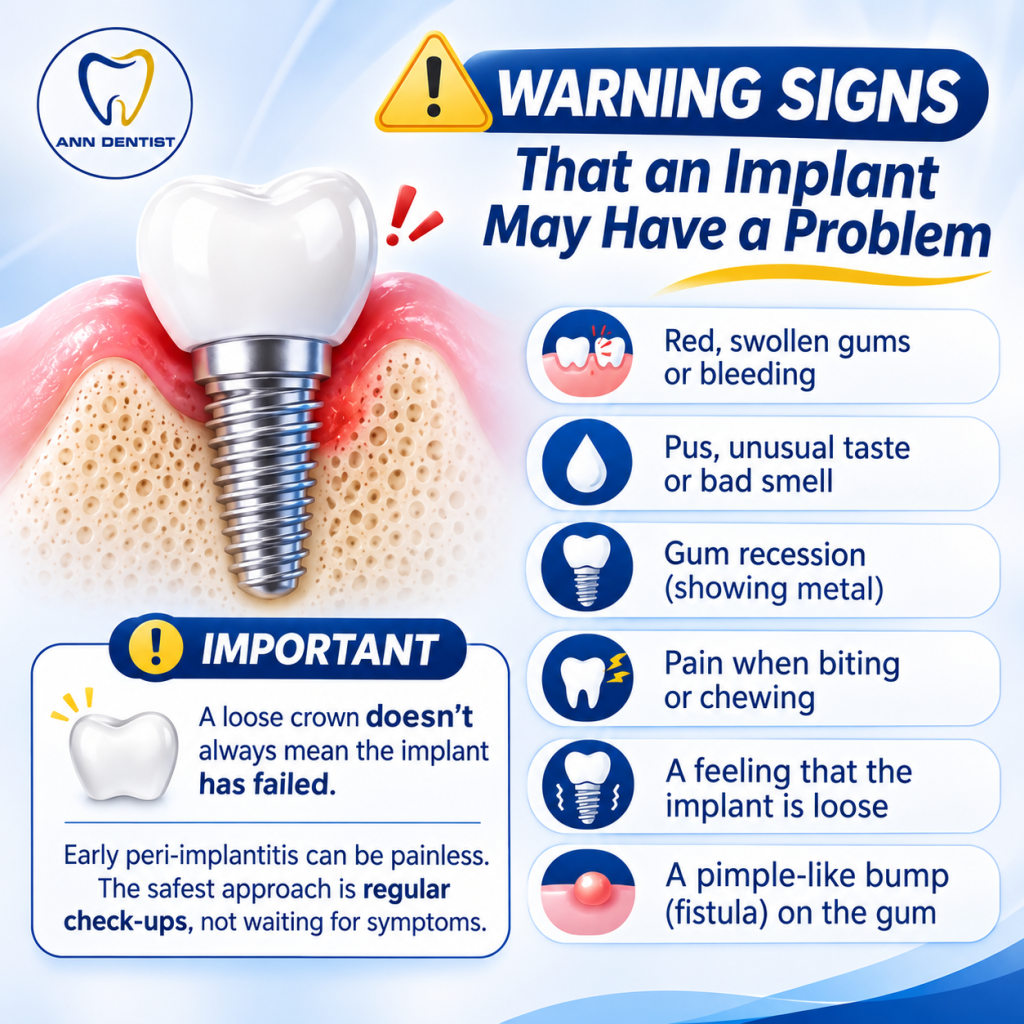
Warning Signs That an Implant May Have a Problem
See your dentist promptly if you notice any of the following:
- Red, swollen gums around the implant, or bleeding when brushing or flossing.
- Pus, an unusual taste or a bad smell coming from around the implant.
- Gum recession that exposes the threads or metal of the implant.
- Pain or discomfort when biting or chewing.
- A feeling that the implant or tooth is loose.
- A small pimple-like bump (fistula) on the gum.
Important: a loose crown does not necessarily mean the implant has failed. Often the cause is simply a loose screw that can be tightened. On the other hand, early peri-implantitis can be painless. The safest approach is regular check-ups rather than waiting for symptoms.
How Is an Implant Problem Treated?
Treatment depends on the cause and severity:
- Peri-implant mucositis: professional cleaning and renewed hygiene instruction. This stage is usually reversible.
- Mild to moderate peri-implantitis: deep mechanical cleaning, sometimes with local antimicrobial agents. Surgical cleaning and bone grafting may be needed to regenerate lost bone.
- Crown or screw problems: tightening the screw, adjusting the bite, or repairing or remaking the crown.
- Implant that has completely lost osseointegration (truly mobile) or has severe bone loss: the implant usually has to be removed. After the site heals, the dentist may graft bone and place a new implant if conditions allow.
The earlier a problem is found, the greater the chance of saving the implant, and the lower the cost and treatment time.
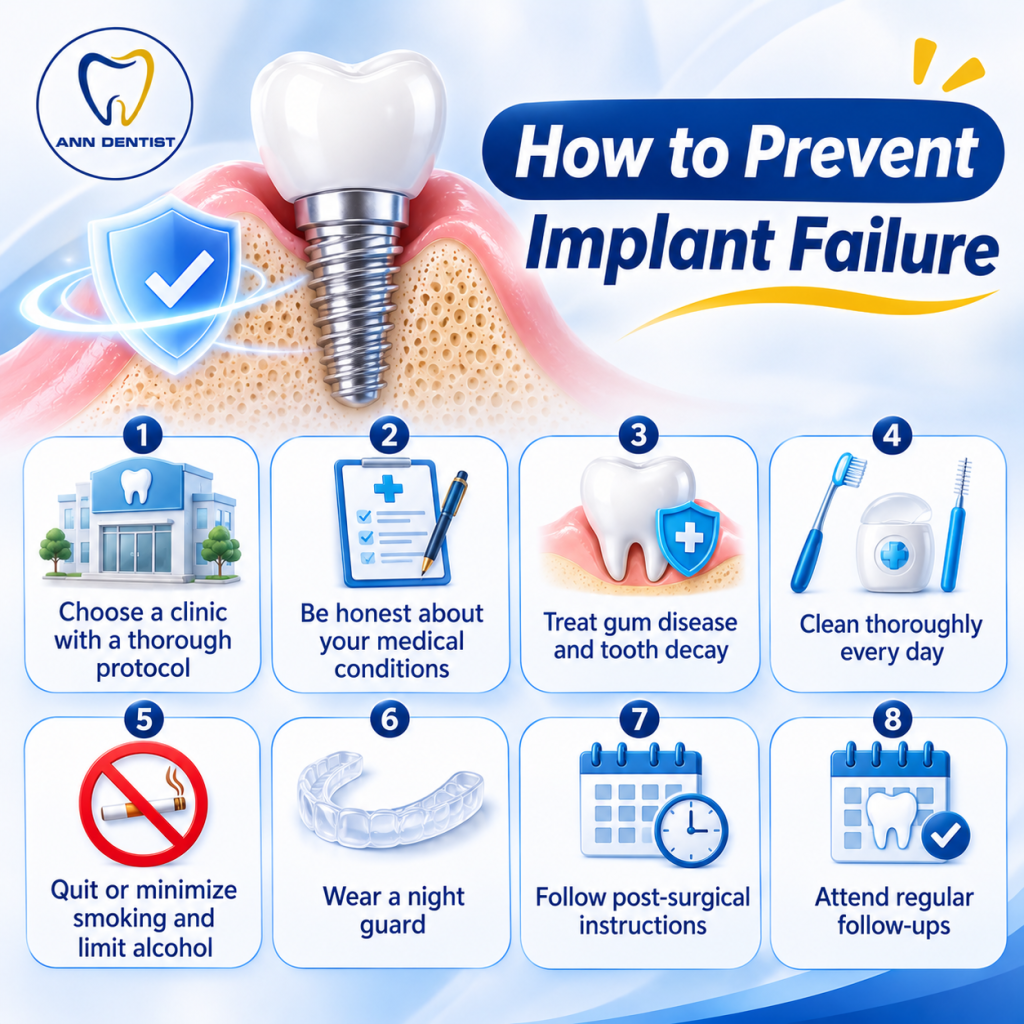
How to Prevent Implant Failure
- Choose a clinic with a thorough protocol: a detailed examination, a CBCT scan, a clear treatment plan and a full explanation of the procedure.
- Be honest about your medical conditions, medications, smoking and alcohol use.
- Treat gum disease and tooth decay before implant surgery.
- Clean thoroughly every day: brush twice daily and clean between teeth with floss, interdental brushes or a water flosser as instructed.
- Quit or minimize smoking and limit alcohol.
- Wear a night guard if you grind your teeth.
- Follow post-surgical instructions, especially regarding diet and when you may begin chewing on the implant.
- Attend regular follow-ups, typically every 3 to 6 months in the first year, then as your dentist recommends.
Frequently Asked Questions
Q. Is implant rejection caused by an allergy to titanium?
Titanium allergy is uncommon. Most failures are related to infection, impaired healing, surgical technique or bite forces.
Q. Can a failed implant be replaced?
Often, yes. After the implant is removed and the site has healed, the dentist can graft bone if needed and place a new implant. The cause of the first failure must be identified and addressed to avoid a repeat.
Q. How long until I can feel safe?
There is no point at which risk disappears entirely. Osseointegration takes several months, but the risk of peri-implantitis lasts as long as the implant is in your mouth. Good hygiene and regular check-ups are lifelong habits.
Q. Can people with diabetes get dental implants?
Yes, if blood sugar is well controlled. The dental team and the doctor managing the diabetes should work together.
Q. Do I still need check-ups once my implant is finished?
Yes. Implants cannot get cavities, but the gum and bone around them can become inflamed, often without obvious symptoms.
Conclusion
Implant “rejection” is usually not an immune reaction. More often it is the result of infection, impaired healing, surgical or planning problems, or excessive bite forces. The six causes to know are poor hygiene and infection around the implant, smoking, medical conditions and medications, insufficient bone or technical errors, excessive biting force, and a history of gum disease combined with skipped check-ups. The good news is that most of these can be prevented by choosing a reputable clinic, being honest about your health, keeping up daily hygiene and attending regular check-ups. If you have an implant and notice any warning sign, book an evaluation rather than waiting.


Có thể bạn quan tâm
CẤU TRÚC TRỤ IMPLANT – BẠN ĐÃ BIẾT CHƯA?
MÀI RĂNG KHI BỌC SỨ BAO NHIÊU MM? CÓ HẠI TỦY KHÔNG?
RĂNG SỨ KHÔNG PHẢI LÀ “ÁO GIÁP” CHỐNG VI KHUẨN